30 Days Access
Focused final review before your exam date.
$79One Time
One exam bank
Unlimited practice
Detailed explanations
Progress tracking

HESI Exit Exam Prep
Prepare for the HESI PN Exit Exam with full-length practice exams, detailed rationales, and progress tracking built around NCLEX-PN content.
Program Signal
HESI PN Exit practice
Program Signal
NCLEX-PN readiness
Program Signal
Final-term review
Exam Coverage
The HESI Exit Exam is taken near the end of a nursing program to check readiness for the NCLEX. It draws on the whole curriculum at once, so strong preparation means mixed practice across client needs, steady pharmacology and safety review, and rationales that explain the reasoning behind each answer. Our HESI Exit course currently includes HESI PN Exit practice exams for practical and vocational nursing students.
Care management
01
Patient safety
02
Lifespan care
03
Mental health
04
Foundational nursing
05
Medication safety
06
Monitoring & labs
07
Acute changes
08
Simple Access
Choose a One Time access window for the exam bank you are preparing for. Every plan includes unlimited practice, detailed rationales, and progress tracking.
Focused final review before your exam date.
One exam bank
Unlimited practice
Detailed explanations
Progress tracking
Extended access with maximum flexibility.
One exam bank
Unlimited practice
Personalized plans
Pass guarantee support
Score, timing, and readiness details to help you plan your preparation.
Exam Purpose
NCLEX
The exit exam checks readiness for NCLEX-style questions across the whole program
Score Format
HESI Score
Results are reported as a weighted HESI score, not a simple percentage
Common Benchmark
850–900
Many programs set their benchmark in this range; your school sets the exact score
Study Timing
Final Term
Most students take the exit exam in their last term, before graduation
Question Bank Platform
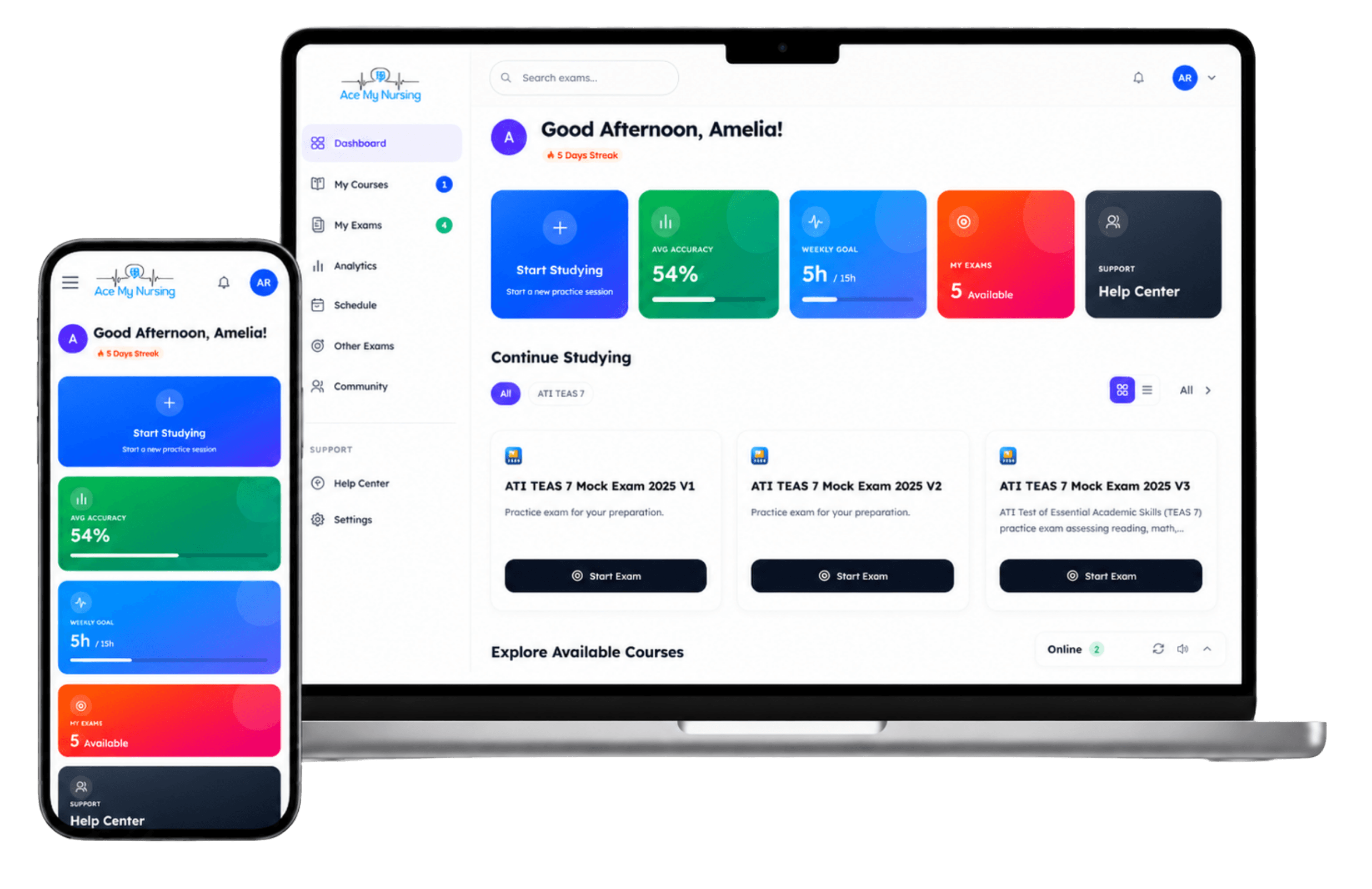
Practice, review rationales, and track your progress in one place, on any device.
Full-length HESI PN Exit practice exams
Detailed answer rationales
Single-answer and select-all-that-apply questions
Dosage calculation and drop-down items
Mixed NCLEX-PN client need coverage
Answer review after every attempt
Performance breakdown by topic
Mobile-friendly final exam preparation
Study Workflow
A simple routine that turns practice results into a focused study plan.
Start with one full practice exam to see where you stand across client needs before you plan the rest of your review.
Group missed questions by area, such as pharmacology, safety, or physiological adaptation, and review those topics before your next exam.
Review the rationale for every question, including the ones you got right, so you understand why each option is correct or incorrect.
Exit exams are long. Complete full practice exams in one sitting so focus and pacing feel familiar on test day.
Prepare for the HESI PN Exit Exam with a clear study plan, practice exams, rationales, score guidance, and NCLEX-PN readiness tips.
The HESI Exit Exam is a standardized, computer-based assessment that many nursing programs give near graduation. It covers content from across the whole program and is used to gauge how ready a student is for the NCLEX. Many students and schools also call it the E2. There are separate versions for registered nursing (RN) and practical nursing (PN) students. Your program may use the exam as a graduation requirement, as part of a capstone course, or as a checkpoint before it approves you to sit the NCLEX.
The PN version is written for practical and vocational nursing students and follows the NCLEX-PN test plan. Questions cover coordinated care, safety and infection control, health promotion and maintenance, psychosocial integrity, basic care and comfort, pharmacological therapies, reduction of risk potential, and physiological adaptation. Because the exam pulls from every course, it is not enough to review only your most recent class. Fundamentals, medical-surgical nursing, maternal-newborn care, pediatrics, mental health, and pharmacology can all appear in the same sitting.
The HESI Exit Exam is taken on a computer in one proctored sitting. Recent versions include Next Generation NCLEX-style items alongside traditional multiple-choice and select-all-that-apply questions, so expect case-based questions that test clinical judgment as well as recall. The number of questions, the time allowed, and whether you may retake the exam depend on the version your school uses and on its own policies. Always follow your program’s instructions.
HESI results are reported as a HESI score rather than a simple percentage. The score takes the difficulty of each question into account, so two students with the same number of correct answers can receive different scores. Your score report also breaks performance down by content area. That breakdown is one of the most useful study tools you have: it shows exactly which client needs and specialty areas to remediate first.
Each nursing program sets its own benchmark. Many programs ask for a HESI score between 850 and 900, and some require students who score below the benchmark to complete remediation before a retake. Check your syllabus or student handbook for the exact score, the number of attempts allowed, and what happens if you do not meet the benchmark on your first attempt.
Start with a baseline practice exam, then let the results guide your plan. A practical six-week plan can look like this: Week 1, take a full practice exam and sort missed questions by client need. Week 2, review fundamentals, safety, and infection control. Week 3, focus on pharmacology and dosage calculation. Week 4, review medical-surgical nursing and physiological adaptation. Week 5, cover maternal-newborn, pediatrics, and mental health. Week 6, take another full practice exam and close the remaining gaps. Short daily sessions work better than long weekend cramming. Even thirty minutes of mixed questions with careful rationale review adds up over a few weeks.
Practice questions are most useful when you read the rationale for every item. The correct answer tells you what to choose; the rationale tells you why, and why the other options are weaker. That reasoning is what carries over when the exam presents a scenario you have not seen before. After each practice exam, write a short note in your own words for every missed concept. Over a few weeks, those notes become a personal study guide built around your actual gaps.
Many students wait until the final weeks to start, study only the subjects they feel comfortable with, or memorize answers without understanding the concept. Others take practice exams but skip the review, which wastes most of the value of each attempt. Another common mistake is never practicing a full-length exam in one sitting. Exit exams are long, and stamina matters. Build up to complete practice exams so the length of the real exam does not catch you off guard.
Our HESI Exit course includes HESI PN Exit practice exams with detailed rationales, answer review after every attempt, and a performance breakdown that shows where to focus next. You can study on a laptop, tablet, or phone and retake exams to track your improvement. The goal is not to memorize answers. It is to understand the content, learn from every wrong answer, and walk into your exit exam with a clear picture of your readiness.
In the last week, focus on review rather than new material. Revisit the rationales you found hardest, rest well the night before, and arrive early so you start the exam calm. During the exam, read each question stem carefully, look for what the question is really asking, and choose the option that keeps the client safest. Trust the preparation you have done.
Here to help
Answers to common questions about preparing for your exam.
Still have a question? Talk to our team
Choose an access plan and start reviewing realistic test bank questions today.

Ace My Nursing Exams
Replies within 3 min
Ace My Nursing Exams
Always here to chat