30 Days Access
Perfect for focused, short-term preparation.
$69One Time
One exam bank
Unlimited practice
Detailed explanations
Progress tracking

ATI Level 3 Prep
Study updated ATI-style questions for Fundamentals, Med-Surg, Pharmacology, and Comprehensive Predictor readiness.
Program Signal
2,000+ questions
Program Signal
Predictor review
Program Signal
Level 3 explanations
Exam Coverage
ATI preparation spans proctored exams across the nursing curriculum, including Fundamentals, Pharmacology, Medical-Surgical, Maternal Newborn, Pediatrics, Mental Health, Community Health, and Leadership.
Foundation
01
Medication prep
02
Advanced concepts
03
Maternal care
04
Pediatric care
05
Psychiatric care
06
Population health
07
Management
08
Simple Access
Choose a One Time access window for the exam bank you are preparing for. Every plan includes unlimited practice, detailed rationales, and progress tracking.
Perfect for focused, short-term preparation.
One exam bank
Unlimited practice
Detailed explanations
Progress tracking
Most popular choice for comprehensive preparation.
One exam bank
Unlimited practice
Study plans
Advanced analytics
Extended access with maximum flexibility.
One exam bank
Unlimited practice
Personalized plans
Pass guarantee support
Important score, timing, and readiness details from the original exam bank pages, rebuilt in the template style.
Level 3 Goal
Focused
Practice is organized around high-scoring performance
Predictor Prep
Included
Practice supports Comprehensive Predictor readiness
Specialty Exams
8+
Major ATI proctored areas are represented
Practice Mode
Timed
Use standard and proctored-style sets for exam readiness
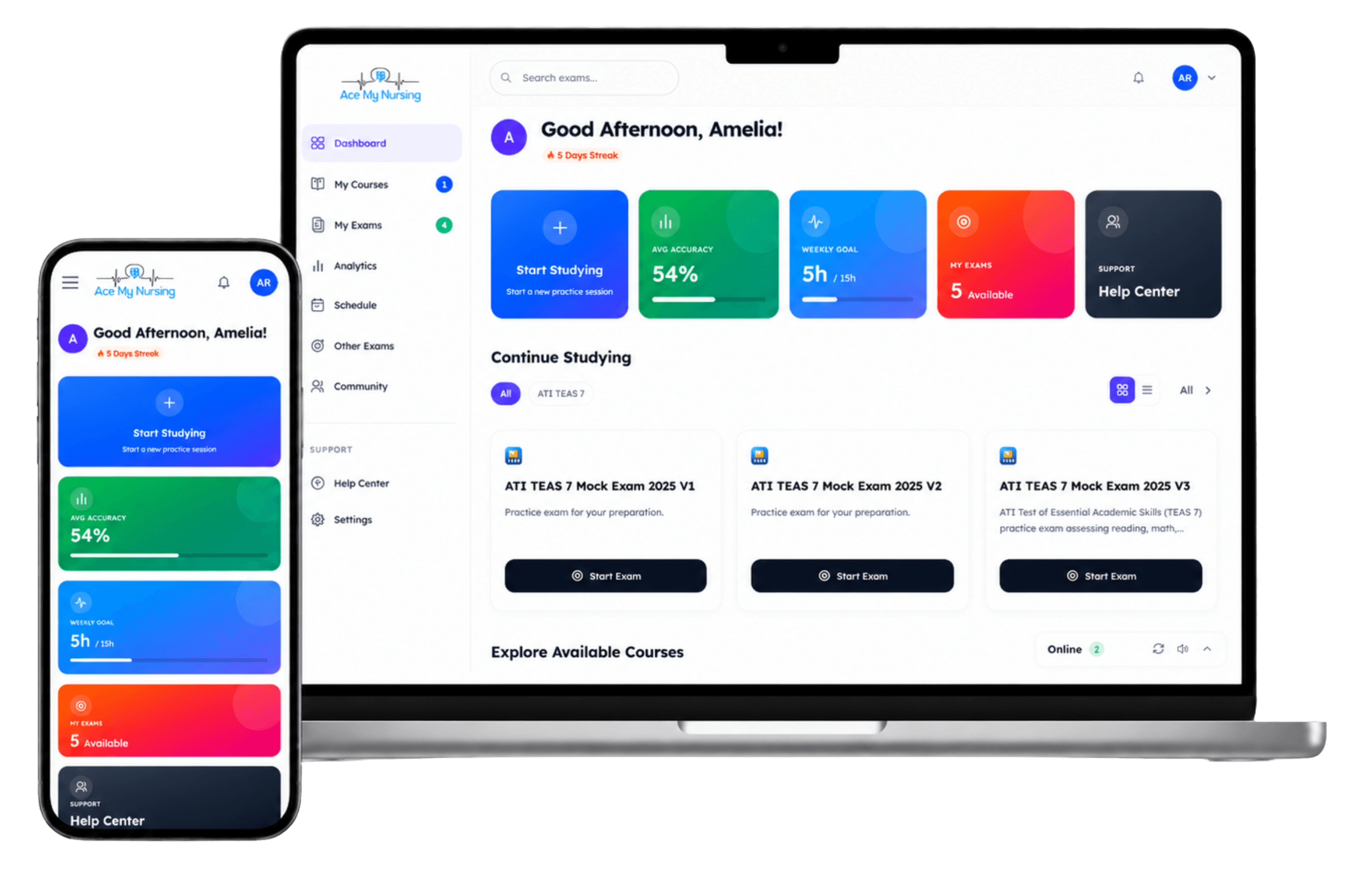
Question Bank Platform
These are the concrete features transferred from the front exam-bank pages, now structured in the current template language.
Comprehensive question banks for all ATI proctored exams
Detailed explanations for every answer
Performance tracking and weak-area review
Updated content aligned to current ATI formats
Standard and proctored-style practice
Predictor assessment simulation
Study Workflow
Each prep page is designed to explain how the student moves through the platform, not just list features.
Review ATI topics as they appear in your nursing program instead of waiting until finals.
Use missed questions to identify whether the gap is content, priority, or test strategy.
Use timed practice before ATI proctored exams so pacing feels familiar.
Use performance trends to decide when to move from topic review to mixed predictor-style sets.
Use this ATI Test Bank guide to prepare with practice questions, rationales, review strategies, scores, question types, and nursing exam study tips.
An ATI test bank is a collection of nursing questions, practice activities, quizzes, and exam-style review materials used to help students prepare for ATI assessments, TEAS, nursing school exams, and NCLEX-style testing. For many nursing students, these resources provide a structured way to review content, improve scores, and build confidence before test day. The purpose of an ATI-style question bank is not to memorize answers or search for unauthorized exam files. The real value comes from completing practice questions, reviewing rationales, checking every incorrect answer, and learning the concept behind each topic. At AceMyNursingExams.com, this page is designed to help students understand how to use ATI test bank resources responsibly, how to review answer choices, and how to prepare for ATI-style exams without depending on unreliable or outdated materials.
An ATI test bank is a structured collection of practice questions arranged by subject, course, or exam focus. These questions help nursing students review what they have learned in class and apply that knowledge to exam-style scenarios. A good question bank may cover Fundamentals of nursing, Pharmacology, Medical-Surgical nursing, Mental Health, Maternal-Newborn nursing, Pediatrics, Community Health, Leadership, Nutrition, TEAS test preparation, and NCLEX-style clinical judgment. The best test bank content helps students prepare by showing how questions are written, how answer choices are structured, and how rationales explain the correct answer.
ATI review matters because many nursing programs use ATI assessments throughout the curriculum. Students may take ATI exams in Fundamentals, Pharmacology, Medical-Surgical nursing, Mental Health, Maternal-Newborn, Community Health, Leadership, and Comprehensive Predictor preparation. A test bank helps students move beyond passive study. Instead of only reading notes, students are taking questions, reviewing answers, and learning why a choice is correct or incorrect. This active review supports long-term understanding and can reduce anxiety because exam wording and reasoning feel less unfamiliar.
ATI-style practice questions are useful because they often follow NCLEX-style thinking. They may ask what the nurse should do first, which client has priority, what action is safest, or which finding needs immediate follow-up. A strong ATI test bank should help students practice clinical judgment, prioritization, delegation, safety, infection control, pharmacology, client teaching, lab interpretation, risk reduction, and nursing process. The NCLEX now places strong emphasis on clinical judgment, so students should prepare with questions that test reasoning, not just memory.
Some students search for ATI test bank materials while preparing for the TEAS test. The TEAS is different from nursing course exams because it is an entrance exam used before admission into many nursing and allied health programs. The TEAS test focuses on reading, math, science, and English and language usage. If you are preparing for the TEAS exam, use TEAS-specific practice questions instead of general nursing course questions. TEAS content is designed for admission preparation, while ATI nursing test bank content is usually used after students begin nursing school.
ATI-style questions can include several formats. Multiple-choice questions usually provide several answer choices with one correct answer. These questions test whether you can identify the safest, most accurate, or highest-priority response. Select-all-that-apply questions may have more than one correct answer and require careful reading because each option must be judged independently. Ordered response questions ask students to place actions in the correct sequence. Clinical judgment scenarios may include a client situation, assessment findings, lab results, or changes in condition. Case-based questions may give a longer client scenario and ask several related questions.
Practice questions are the core of any ATI test bank. They help students apply what they have learned and prepare for the way nursing exams are written. When completing practice questions, do not rush. Read the stem carefully, look for priority words, compare answer choices, and remove unsafe options. If a question asks what the nurse should do first, the answer may be different from a question asking what the nurse should do next. Good practice questions should include explanations because the actual exam may test the same concept using different language.
Answers alone are not enough. Rationales are what make a test bank useful. A correct answer tells you the result. A rationale tells you the reason. When you study rationales, you learn the concept behind the question. A strong review process should include the topic tested, the answer chosen, the correct answer, the rationale, the reason the wrong answer was tempting, and the rule or concept to remember. This process turns every question into a learning opportunity.
Incorrect answers are not wasted effort. They show exactly where your study plan needs focus. When you miss a question, ask whether you missed a key word, chose a safe answer but not the best answer, confused two similar topics, forgot a nursing priority rule, failed to apply ABCs, Maslow, or safety, or misunderstood the client scenario. If you keep missing pharmacology questions, focus on medication classes. If you miss prioritization questions, review urgent versus non-urgent findings. If you miss delegation questions, study what the RN can and cannot delegate.
Your study time depends on your goal, current scores, and exam date. Some students need a short review before an ATI exam. Others need several weeks of preparation for a major assessment or NCLEX-style test. A simple study schedule can look like this: Week 1, complete a baseline question set and review scores. Week 2, focus on the weakest subject area. Week 3, complete mixed practice questions daily. Week 4, review incorrect answers and complete a timed test. This step-by-step plan helps students avoid random study and keeps review focused on progress.
Use this process when completing ATI-style review: choose one subject or topic, complete a timed set of practice questions, review your answers, read the rationales, write a short comment for every missed item, track your scores, repeat the weak topic, and take a mixed review test. This step process helps students move from basic review to stronger understanding. It also helps avoid wasting time on content already mastered.
Tracking scores is important because it shows whether your study method is working. Do not only take one test and stop. Take a baseline test, review weak areas, then take another practice test after focused study. Track total score, subject score, topic score, incorrect questions, repeated weak areas, time spent completing each set, and progress over time. If your scores are not improving, change your method. Reading notes may not be enough.
Many ATI-style exams and reviews are completed on a computer. Students must be comfortable reading long questions on a screen, clicking answer choices, moving between items, and managing time. Before test day, practice on a computer or mobile device if the website supports it. For longer exams, a computer is usually better than a mobile device because the page is easier to view and long questions are less tiring to read. Check your login, browser, internet connection, and testing instructions early.
A mobile device can be helpful for quick review, flashcards, or short question sets. However, it may not be the best option for completing a long exam-style review. Small screens can make it harder to view all answer choices, read case studies, and compare details. Use a mobile device for short study sessions. Use a computer for full-length practice tests, timed review, and serious exam preparation.
Sometimes students are unable to access a website because of login issues, expired accounts, browser problems, security filters, or school restrictions. If this happens, refresh the page, check your internet connection, clear browser cache, try a different browser, confirm your account login, check whether access expired, and contact support or your school. If you see a security message, avoid repeatedly submitting the same action. Take a screenshot and contact the website owner or your school support team.
Students should be careful with unauthorized test bank files online. Some may be outdated, inaccurate, copied without permission, or not aligned with current exam plans. Using poor materials can hurt your scores because you may learn the wrong content or memorize answers that do not match the real exam. Use updated study resources that focus on reasoning, rationales, and clinical judgment. Avoid any page that promises guaranteed exam answers, leaked files, or exact live test questions.
On test day, read each question carefully. Look for key words such as first, priority, best, most appropriate, immediate, and needs further teaching. These words change the meaning of the question. Read the full question before looking at answers, identify the topic, remove unsafe answer choices, apply priority frameworks, avoid changing answers without a reason, watch the clock, and stay calm after difficult questions.
AceMyNursingExams.com helps nursing students prepare with ATI-style study resources, practice questions, rationales, and exam review support. Whether you are preparing for a TEAS test, a nursing school assessment, or NCLEX-style questions, structured review can help you improve. Start with a baseline question set, review your scores, identify weak topics, and focus on rationales. The more you understand the reason behind each answer, the better prepared you will feel when taking the real exam.
Quick Answers
Clear answers about exam sections, scores, retakes, timing, costs, and first-try preparation.
An ATI test bank is a collection of practice questions, quizzes, and review materials used to help nursing students prepare for ATI-style exams, course assessments, TEAS, and NCLEX-style testing.
Choose an access plan and start reviewing realistic test bank questions today.

Ace My Nursing Exams
Replies within 3 min
Ace My Nursing Exams
Always here to chat