30 Days Access
Perfect for focused, short-term preparation.
$69One Time
One exam bank
Unlimited practice
Detailed explanations
Progress tracking

TEAS 7 Practice
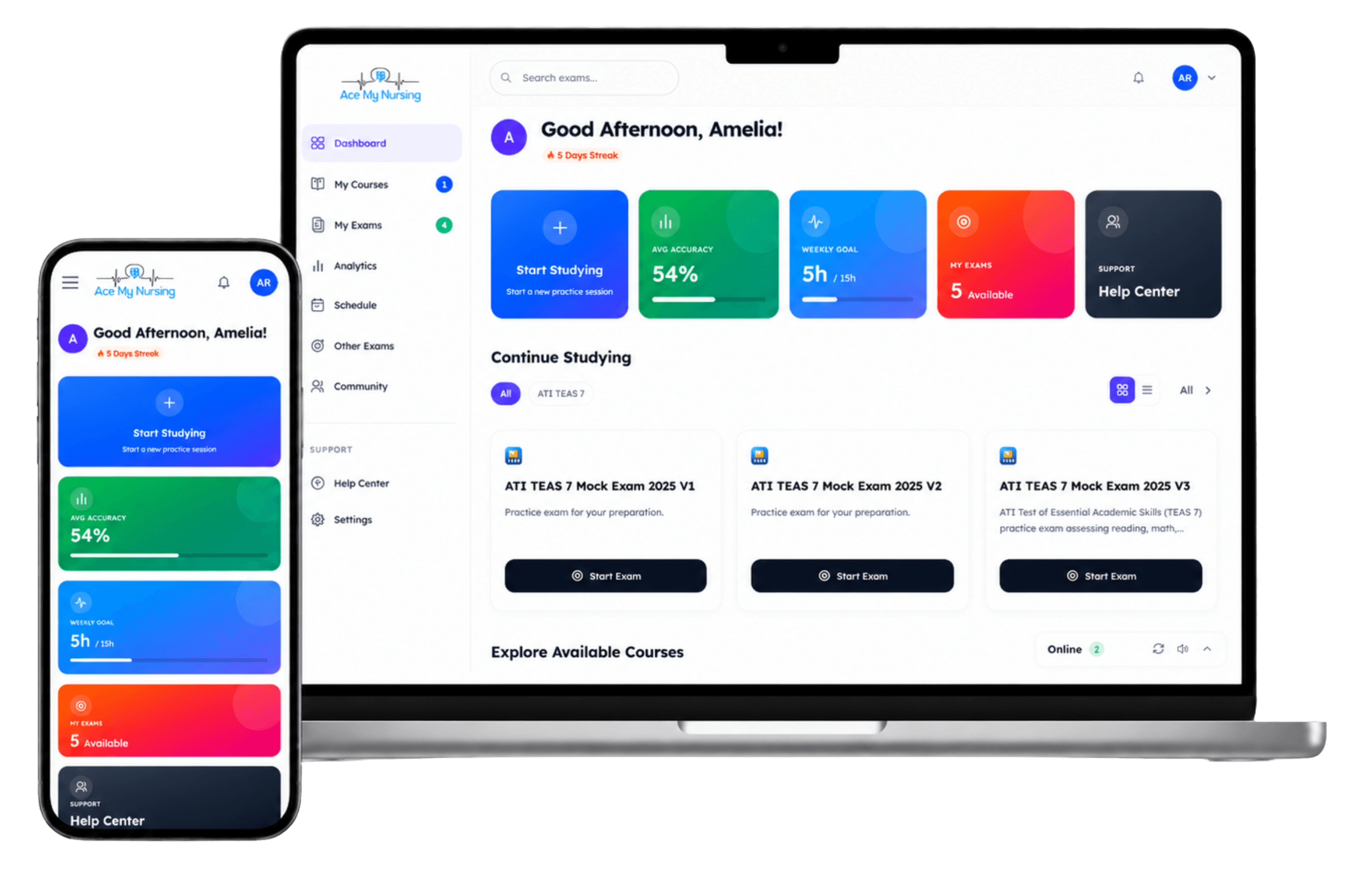
Simulate the real TEAS 7 exam with timed tests, mini-quizzes, answer keys, and detailed performance breakdowns.
Program Signal
5,000+ questions
Program Signal
All 4 subject areas
Program Signal
Timed test practice
Exam Coverage
The ATI TEAS 7 measures academic readiness in reading, mathematics, science, and English language usage for nursing and health science programs.
53 questions · 64 minutes
01
36 questions · 54 minutes
02
53 questions · 63 minutes
03
28 questions · 28 minutes
04
Simple Access
Choose a One Time access window for the exam bank you are preparing for. Every plan includes unlimited practice, detailed rationales, and progress tracking.
Perfect for focused, short-term preparation.
One exam bank
Unlimited practice
Detailed explanations
Progress tracking
Most popular choice for comprehensive preparation.
One exam bank
Unlimited practice
Study plans
Advanced analytics
Extended access with maximum flexibility.
One exam bank
Unlimited practice
Personalized plans
Pass guarantee support
Important score, timing, and readiness details from the original exam bank pages, rebuilt in the template style.
Competitive Programs
85-90%
Top-tier nursing schools often require this range
Most Programs
75-85%
Standard requirement for many programs
Minimum Passing
70-75%
Basic admission threshold for some programs
Testing Time
209 Min
Allocated time for the full ATI TEAS 7 exam
Question Bank Platform
These are the concrete features transferred from the front exam-bank pages, now structured in the current template language.
5,000+ TEAS 7 practice questions
Full-length TEAS simulation exams
Section-specific practice tests
Detailed explanations for every question
Personalized study recommendations
Progress tracking and analytics
Mobile-friendly study platform
Instant score reports with breakdown
Study Workflow
Each prep page is designed to explain how the student moves through the platform, not just list features.
Focus on math operations, reading comprehension, and core science concepts.
Each section has a specific time limit, so pacing must be trained before test day.
Study medical terminology and academic vocabulary to improve reading and English performance.
Rotate anatomy and physiology, life sciences, physical sciences, and scientific reasoning.
Prepare for the TEAS 7 exam with a free TEAS practice test guide, question types, scores, practice questions, study time, costs, and ATI TEAS test day tips.
The TEAS 7 is one of the most important entrance exams for students applying to nursing and allied health programs. The test is officially known as the ATI TEAS, and many schools use it to measure whether applicants are ready for the academic work required in healthcare training. The exam checks basic skills in reading, math, science, and English and language usage. Many students search for a TEAS practice test because they want to know what the real exam feels like before test day. A strong practice plan helps you understand question types, improve your scores, review incorrect answers, and build confidence before your test date. At AceMyNursingExams.com, this TEAS 7 prep page is designed to help you prepare with clear explanations, realistic practice questions, score guidance, and study strategies.
The ATI TEAS is a standardized entrance exam used by nursing and allied health programs to assess academic readiness. ATI states that the exam evaluates basic academic skills in reading, math, science, and English language usage. The TEAS 7 exam includes 170 total questions and 209 minutes of allocated testing time. ATI lists the question types as multiple choice, multiple select, fill in the blank, ordered response, and hot spots. Students should study both the subject material and the way the test asks questions.
The TEAS 7 exam is divided into four major test sections: Reading, Math, Science, and English and language usage. ATI’s official TEAS 7 content-area breakdown lists 39 scored reading questions, 34 scored math questions, 44 scored science questions, and 33 scored English and language usage questions. The full exam includes scored and unscored questions, including 20 unscored pretest items, so treat every item seriously.
A free TEAS practice test is a helpful starting point for students who want to see their current level before buying study materials. It gives you a quick picture of your strengths and weaknesses. You may feel strong in reading but weak in science, or comfortable in math but unsure about English and language usage. Use a free TEAS resource first, then move into a more complete prep plan. A good TEAS practice test should include answer explanations, content area scores, and realistic question types.
A TEAS practice test helps students prepare in the same way they will be tested. It checks how well you understand the subject, manage time, compare answer choices, and recover after difficult questions. Take practice tests under timed conditions. After the test, review every incorrect question and ask whether you misunderstood the question, rushed, forgot a formula, confused two choices, or lacked content knowledge.
Practice questions are useful when you want to focus on one skill at a time. For example, you can complete 20 math questions on percentages, 20 science questions on anatomy, or 20 English and language usage questions on grammar. The best practice questions include explanations. Answers alone are not enough. For TEAS 7 practice, use a mix of subject drills and full-length tests so you improve weak skills, stamina, and timing.
The TEAS 7 uses several question types, including multiple choice, multiple select, supply answer or fill in the blank, hot spot, and ordered response. Multiple choice questions usually have one correct answer. Multiple select questions may have more than one correct answer. Supply answer questions require careful spelling, numbers, rounding, and units. Hot spot questions ask you to click part of an image. Ordered response questions ask you to arrange items in sequence.
The real exam is not just about knowing facts. It is about using knowledge under time pressure. Students often lose points because they rush, panic, or overthink. To prepare for the real exam, practice with a timer. Take at least one full-length practice test before your test date. Simulate exam conditions as closely as possible so test day feels familiar.
Scores are important because many nursing programs use them during admission decisions. Some schools require a minimum total score. Others look at content area scores. Your total score gives an overall picture of performance, while your content area scores show how you performed in each subject. Because each school sets its own requirements, always check the exact TEAS score policy on the program website.
The cost of the TEAS test depends on where you take it. ATI’s help page states that TEAS at ATI exams are $120 and TEAS at PSI exams are $120, while exams taken at institutions or testing centers may vary in cost. ATI also notes that the average ATI TEAS proctored exam cost is about $120 and that rescheduling through ATI may require a $15 fee. Some schools may charge a different amount, and extra score reports or transcripts may cost more.
The math section tests practical skills that healthcare students need. Topics may include whole numbers, fractions, decimals, percentages, ratios, proportions, measurement conversions, algebra, and interpreting data. To improve your math score, review arithmetic, learn common conversion patterns, practice word problems, check units before choosing an answer, and use the formula sheet correctly if one is provided.
The science section is often one of the most challenging parts of the TEAS 7. It may include anatomy and physiology, biology, chemistry, scientific reasoning, and basic physical science concepts. Divide science into smaller subject areas. Study one body system at a time, review key ideas, then complete TEAS practice questions. If you get an answer wrong, go back to the concept before moving forward.
The English and language usage section checks grammar, sentence structure, punctuation, spelling, word meaning, and the ability to express ideas clearly. The section may look simple, but it can be tricky because answer choices often look similar. Review subject-verb agreement, pronouns, punctuation, sentence fragments, run-ons, and word choice. Then apply those rules through practice questions.
The reading section checks comprehension, main ideas, details, inferences, and the ability to understand written information. You may need to identify the author’s purpose, compare ideas, or decide which statement is supported by the passage. Do not choose an answer just because it sounds true. Choose the answer supported by the passage. Strong reading skills also help with textbooks, patient instructions, clinical notes, and healthcare policies.
The amount of study time needed depends on your starting level, test date, and target score. Some students prepare in three weeks. Others need six to eight weeks, especially if they are weak in math or science. A practical schedule can start with a diagnostic TEAS practice test, then move through math, reading, science, English and language usage, full practice tests, weak-area review, and final test-day preparation.
Good TEAS 7 practice should combine full-length tests, short drills, and review sessions. Do not only take tests. A test shows the problem, but review fixes the problem. Use a cycle: take a practice test, record your scores, review incorrect answers, study the weak subject, complete practice questions, and take another test.
A free TEAS practice resource can help you begin without paying immediately. Use it to understand the exam format, test sections, and question types. Free materials may not be enough for everyone. If your school is competitive or your scores are below the required range, use complete study materials, full-length exams, and detailed explanations.
To pass the TEAS the first time, begin early and study with structure. Start with a diagnostic test and identify weak areas. Build a study plan around your lowest scores. On test day, manage your time, read instructions carefully, avoid spending too long on one question, use elimination when answer choices are confusing, and keep moving without rushing through simple details.
AceMyNursingExams.com helps students prepare for the TEAS 7 exam with practice tests, practice questions, study support, and clear explanations. Whether you are taking the TEAS test for the first time or trying to improve your scores, our prep resources can help you study with more focus. Start with a free TEAS practice test, review your content area scores, and build a plan around your weak subjects. The right preparation can help you improve your final score and move closer to nursing school admission.
Quick Answers
Clear answers about exam sections, scores, retakes, timing, costs, and first-try preparation.
The TEAS 7 is an entrance exam used by many nursing and allied health programs. It tests reading, math, science, and English and language usage.
Choose an access plan and start reviewing realistic test bank questions today.

Ace My Nursing Exams
Replies within 3 min
Ace My Nursing Exams
Always here to chat